
Wire Rope Pulley Supplier in India
A wire rope pulley supplier in India needs the rope construction, groove requirement and mounting arrangement. A wheel that spins freely can still shorten rope life when groove geometry or alignment is wrong.
Straight answer
What buyers should know first
For a wire rope pulley, start with the rope—not the outside diameter of the wheel. Share rope construction and diameter, intended line pull, fleet angle, speed and mounting drawing. A sheave that rotates freely but has the wrong groove can still damage the rope.
Product scope
Available configurations and intended use
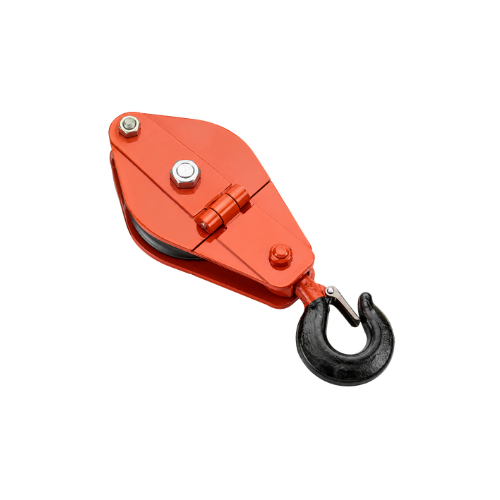
A pulley enquiry may be for a standalone grooved sheave or an assembled block with bearings, axle and side plates. These are not identical products. The current catalogue shows wire rope pulley supply; custom sheave or block requirements should be reviewed against a drawing before availability or rating is assumed.
Engineering selection
How to specify the right part
Check groove radius and depth against the actual wire rope, and confirm the sheave-to-rope diameter ratio required by the rope and equipment design. Bearing selection depends on speed, duty cycle, contamination and maintenance access. The axle, side plates and anchor connection must support the same load path as the sheave.
Technical analysis
The detail that changes the buying decision
A pulley is a rope-and-sheave interface. Groove contour, sheave diameter, fleet angle and bearing drag influence wear, while axle and side plates carry the resulting reaction load. Request the complete assembly drawing when the pulley is part of a lifting system; a sheave-only quote cannot establish block capacity.
Manufacturing review
From drawing to an agreed specification
The quotation review should establish geometry, material, bearing or bush arrangement, surface finish and inspection criteria. A drawing can define pitch diameter, groove profile, runout, bore and mounting dimensions. Where the pulley is part of a lifting system, the complete assembly needs a verified rating; a component dimension alone is not a safe capacity claim.
Evidence and inspection
What quality documentation to request
Ask for relevant dimensional checks on the groove, bore, concentricity and bearing fit, plus material and finish records when required. Inspect sheaves for sharp groove edges, cracks, seized bearings and abnormal rope wear. Replace or repair according to the equipment maintenance procedure.
International procurement
Information overseas buyers should send
Overseas RFQs should include the rope specification, unit system, assembly drawing, operating environment, packaging and inspection documents. Clarify whether the order includes axle, bearing, side plates or only the sheave to prevent a mismatch at installation.
Ready to enquire?
Technical RFQ checklist
A complete first enquiry helps us discuss fit, supply scope and documentation without guessing.
- ✓ Wire rope diameter and construction
- ✓ Sheave or complete pulley block
- ✓ Pitch diameter and groove profile
- ✓ Line pull, speed and duty cycle
- ✓ Bore, axle and bearing arrangement
- ✓ Finish, environment and maintenance
- ✓ Drawing, quantity and inspection documents
Related product families
Choose the page that matches the component, rather than treating different fasteners as interchangeable.
Related buying guides
For a deeper answer to a specific engineering question, start here.
Engineering reference
For specification research, see OSHA 1926.251 — rigging equipment reference (US). This external reference does not mean that every listed product is certified to it. Confirm the applicable edition, product rating and required documents in your approved purchase specification.
Frequently asked buyer questions
Can a pulley be selected using rope diameter alone?+
No. Rope diameter is essential, but groove profile, sheave diameter, line pull, fleet angle, speed, bearing and mounting all affect suitability.
Is a sheave the same as a pulley block?+
A sheave is the grooved wheel. A pulley block includes other load-carrying components such as side plates, axle and bearings. Specify which supply scope you need.
What causes premature wire rope wear?+
Possible causes include an incorrect or worn groove, poor alignment, seized bearing, inadequate sheave diameter and contamination. The whole system should be inspected.
How do I select a pulley for wire rope?+
Start with the rope diameter and construction, then specify groove profile, sheave diameter, line pull, speed, bearing and mounting. A rope-compatible groove is essential for service life.
Quick Summary
A wire rope pulley redirects a moving rope through a grooved sheave. Groove geometry, bearing, alignment and the complete support arrangement affect rope life.
Key Takeaways
- ▸Wire rope diameter and construction
- ▸Sheave or complete pulley block
- ▸Pitch diameter and groove profile
- ▸Line pull, speed and duty cycle